The Energy and Petroleum Regulatory Authority (EPRA) has raised pump prices three times in 2026, and the latest increase, announced on Wednesday, has pushed super petrol and diesel past Sh226 a litre in Nairobi for the first time this year, wiping out every shilling of the early-year relief.
In its review for the 15 October to 14 November cycle, EPRA lifted the price of super petrol by Sh12.93 to Sh226.96 a litre. Diesel rose by Sh9.90 to Sh227.76, and kerosene climbed Sh28.49 to Sh219.87.
Motorists in Mombasa will pay Sh223.80 for petrol, while those in Kisumu will pay Sh226.62. Some reports put the diesel increase at Sh12.04, but the September price of Sh217.86 and the new price of Sh227.76 leave a difference of exactly Sh9.90.
The government also extended the reduced 8 per cent VAT on fuel until 14 January 2027, without which prices would have been higher still.
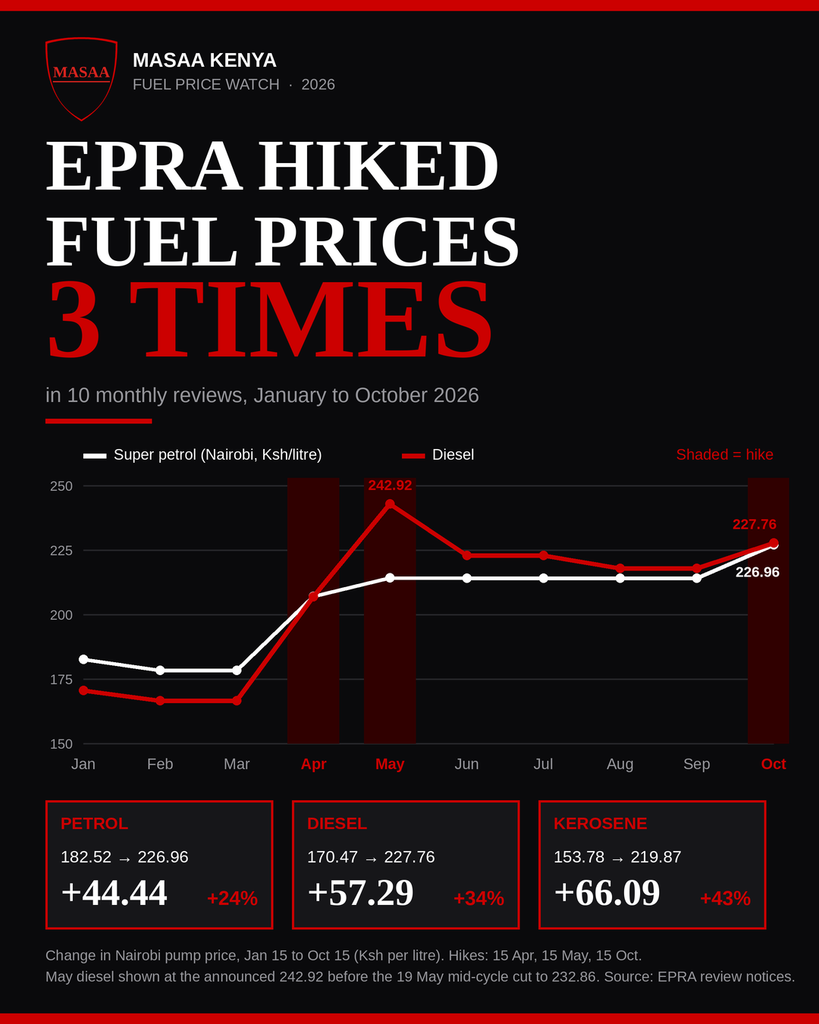
The October hike follows two earlier ones, in April and May, that did far more damage. The year began gently. Prices fell in the January review, with petrol dropping Sh2 to Sh182.52, and fell again in February, when petrol slid to Sh178.28 and diesel to Sh166.54. March brought no change, with EPRA saying at the time that the Middle East situation had not yet filtered into pump prices.
It did not take long. On 14 April, EPRA announced increases of Sh28.69 for petrol and Sh40.30 for diesel, taking them to Sh206.97 and Sh206.84. The authority blamed high landed costs, and the figures bear that out: the average landed cost of super petrol had jumped from about US$582 to US$824 per cubic metre in a single cycle.
The public reaction was swift and angry. Within a day, following a presidential directive, Treasury Cabinet Secretary John Mbadi cut VAT on petroleum products to 8 per cent, and EPRA published revised prices of Sh197.60 for petrol and Sh196.63 for diesel. Even after that intervention, petrol was still Sh19.32 dearer and diesel Sh30.09 dearer than they had been a month earlier, which is why April counts as a hike. Kerosene stayed at Sh152.78, held there by a subsidy that EPRA put at Sh96.56 a litre.
May was worse. On 14 May, EPRA raised petrol by Sh16.65 to Sh214.25 and diesel by Sh46.29 to Sh242.92, the highest diesel price Kenyans had seen in years.
Public backlash
The Matatu Owners Association responded the next day by announcing an immediate 50 per cent fare increase and a countrywide strike set for Monday 18 May, with its president, Albert Karakacha, promising “strictly no movement of any vehicles” and accusing EPRA of being “the biggest place for cartels to tax Kenyans to death.” The strike paralysed transport in many parts of the country, and protesters in Kitengela lit bonfires and barricaded roads. A
Business Daily analysis estimated that motorists and households would spend an extra Sh25.09 billion on fuel between 15 April and 14 June alone.
That night, after about six hours of talks with transport operators, EPRA revised the prices again. Diesel fell Sh10.06 to Sh232.86, petrol stayed at Sh214.25, and kerosene, which had been shielded until then, rose Sh38.60 to Sh191.38. The operators rejected the cut and the strike continued.
A further Sh10 reduction in diesel came in the June review, after the President consulted transport leaders, bringing it to Sh222.86 with about Sh10 billion from the Petroleum Development Levy Fund used to hold down diesel and kerosene. Prices then held steady for the next three months: petrol sat at Sh214.03 from June through September, while diesel eased by a further Sh5 in August to Sh217.86.
The relief was thinner than the headlines suggested. Kenya’s annual inflation rose to 6.8 per cent in September, its highest in a year, with the transport index up 15.6 per cent and food prices up 9.5 per cent, according to figures from the Kenya National Bureau of Statistics.
In April, the Central Bank had expected inflation to peak at 6.2 per cent in July because of the Iran war, a forecast the data have since overtaken. That this happened in a month when EPRA left petrol unchanged shows how long the effects of expensive fuel take to work through the economy, from the matatu fare to the price of tomatoes at the market.
The question now is how long the cushion lasts. Oil and gas consultant Dr Patrick Obath warned in April that the subsidy was unsustainable, noting that a levy of Sh5.40 a litre was funding a subsidy of about Sh22 a litre, so that roughly four months of collections were needed to pay for one month of support. He also questioned why the fund had received only Sh25 billion of a projected Sh55 billion.
“What we have is not enough for what is to come,” he said.
Six months and several billion shillings later, the Treasury has now extended the VAT relief twice, in July and again this week, an arrangement that costs the exchequer revenue at a time when it has little to spare.
Measured from the opening prices of 15 January, a litre of petrol in Nairobi now costs Sh44.44 more, a rise of about 24 per cent. Diesel is up Sh57.29, or 34 per cent, and kerosene is up Sh66.09, or 43 per cent, making it the fuel that has climbed fastest in percentage terms. The next review is due on 14 November.
Counting note: a “hike” here means a monthly review that left the pump price of super petrol and diesel higher than the month before. If the 19 May increase in kerosene is counted, there were four upward moves for at least one fuel. All prices are maximum Nairobi pump prices including taxes, in shillings per litre.